Who's the Best for Document Automation: Nintex vs Process Street
Many teams pick a document automation tool only to find policy updates still require manual chasing across folders and inboxes. The mismatch between what the software promises and what daily compliance actually demands is what stalls approval cycles and creates audit gaps. Your choice now determines whether those gaps close or widen.
By the final section you will see a side-by-side of document control, workflow orchestration, and AI monitoring features, a pricing comparison, and a direct recommendation on which platform fits your compliance workload. The article also states the single scenario where the other option is the clearer fit.
Quick Verdict: Process Street vs Nintex for Document Automation
First sentence: Process Street delivers stronger document automation and compliance features than Nintex for teams requiring audit-ready workflows.
Teams that prioritize document governance need clear audit trails and consistent version control. Process Street provides these controls through its SOC 2 Type II certification and ISO 27001 compliance standards.
AI workflow capabilities differ between the two platforms. Process Street keeps data private and never uses customer information to train AI models, which protects sensitive business documents and maintains compliance requirements.
Organizations using Process Street report faster documentation and reduction in setup time. These improvements help teams move through approval workflows more quickly while maintaining proper security protocols.
Pricing transparency varies between the platforms. Process Street publishes clear pricing information while many enterprise competitors require custom quotes that complicate budget planning for document automation projects.
Compliance-focused organizations benefit from Process Street's certifications and approach to data security. The platform meets HIPAA standards with BAA available upon request, supports GDPR requirements, and maintains CCPA compliance for different regulatory environments.
At a glance: how Process Street compares to Nintex on the features that matter most.
| Feature | Process Street | Nintex |
|---|---|---|
| Document Automation | ✓ | ✓ |
What Is Process Street?
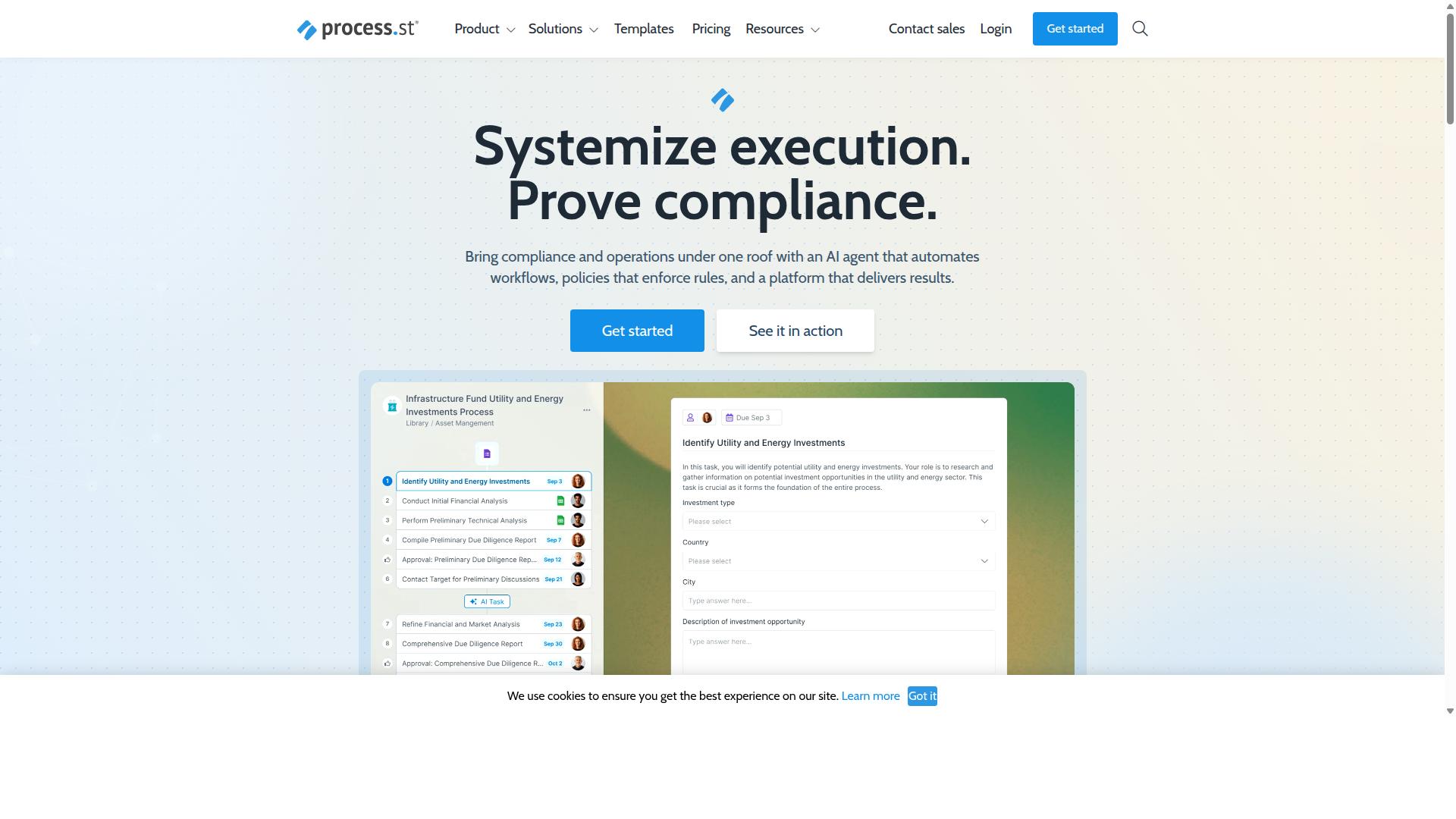
Process Street operates as a compliance operations platform that automates business processes and enforces policies with audit-ready proof. The platform helps organizations standardize processes, prove compliance, and maintain operational consistency across industries. Organizations use it to meet strict regulatory requirements while keeping daily operations efficient.
Process Street offers three main products. Docs handles document management and policy control. Ops manages workflow automation and process orchestration. Cora functions as an AI compliance and risk agent. Each product addresses specific needs in compliance and operations management.
The document management capabilities support multiple compliance frameworks. These include ISO 9001, SOC 2, SOX, and FDA requirements. Organizations rely on these features to maintain proper documentation and evidence for audits.
Ops converts policies into AI-powered workflows. This approach helps teams execute procedures consistently while maintaining compliance records. The automation reduces manual errors and speeds up routine tasks.
Over 3,000 companies and 1m+ users already use the system. These organizations span various industries and sizes. The adoption rate reflects the platform's ability to handle complex compliance and automation needs.
What Is Nintex?
Nintex provides workflow automation and document generation tools for enterprise process management across industries. The platform combines form building capabilities with automated business process management features. Organizations turn to Nintex when they need structured approaches to handling complex approval workflows.
The software includes web-based process mapping tools that let teams visualize their operations. Users can design and adjust these maps without writing code in most cases. This visual approach helps teams identify bottlenecks and streamline their document automation efforts.
Approval workflow features allow organizations to route documents through multiple stakeholders automatically. The system tracks changes and maintains records throughout the approval process. These capabilities make Nintex suitable for companies that require formal business process management structures.
Form builder functionality lets users create custom input forms that trigger workflows once submitted. These forms can include conditional logic that changes questions based on previous answers. The result is a more flexible system for capturing information needed for document generation.
Nintex serves as an enterprise software solution across multiple industries. Companies use it for compliance management, audit trails, and maintaining consistent processes at scale. The platform offers both cloud deployment options and on-premise deployment depending on organizational requirements.
Features Compared
The feature comparison breaks down three critical areas for document automation and workflow management.
Both platforms handle core document automation functions. Process Street distinguishes itself through integrated governance capabilities that span multiple regulatory requirements.
Workflow depth varies significantly between the two solutions. Process Street converts policies directly into executable sequences. This approach reduces the gap between documentation and actual process execution.
AI capabilities represent another key differentiator. Process Street includes dedicated compliance monitoring features that operate continuously throughout workflow execution.
Document Management & Policy Control
Process Street provides document management with full governance controls for ISO 9001, SOC 2, SOX, and FDA compliance requirements.
Version control ensures teams work with current policy documents. Approval workflows route documents through designated stakeholders before implementation. Audit trails capture every modification with timestamps and user attribution.
Governance capabilities support multiple regulatory frameworks simultaneously. Organizations maintain compliance across different standards without separate documentation systems. This unified approach reduces administrative overhead.
Document storage includes organized retrieval mechanisms. Teams locate specific policies quickly through structured categorization.
Workflow Automation & Process Orchestration
Process Street converts documented policies into AI-powered workflows that orchestrate tasks across teams and systems.
Policy documents transform into automated sequences through structured workflows. Conditional logic triggers specific actions based on document content or user responses. Task assignment distributes work to appropriate team members automatically.
Notification systems keep stakeholders informed throughout process execution. API connectivity enables integration with external systems and applications. The Startup plan includes 10 automation apps for expanded functionality.
Workflow creation follows a direct path from policy to execution. Teams avoid manual translation steps that introduce errors. This direct conversion maintains policy accuracy while accelerating implementation timelines.
AI-Powered Compliance Monitoring
AI monitoring in Process Street continuously checks workflow execution against compliance requirements and generates real-time audit reports.
AI identifies compliance gaps during active workflow execution. The system flags deviations before they create regulatory issues. Automated audit trail generation captures compliance evidence without manual intervention.
Reporting capabilities produce regulatory documentation automatically. Teams access compliance status reports without compiling data from multiple sources. This automation reduces preparation time for audits and reviews.
SOC 2 Type II and ISO 27001 certifications underpin these monitoring features. Process Street maintains these certifications to support enterprise compliance needs. The platform ensures data security while monitoring regulatory adherence.
Pricing Compared
Process Street offers three distinct pricing tiers while Nintex pricing structures differ in transparency and packaging. The clear tier options help organizations evaluate costs based on their specific needs.
The Startup plan provides a simplified approach for growing businesses. This plan includes unlimited workflows and tasks with up to 5,000 Data Set records. Users get access for 5 team members and 10 guests.
Automation capabilities include 10 automation apps with a 100 automation actions per month limit. The plan also provides Public API access at 50 calls per month. A 14-day free trial on the Pro plan requires no credit card.
The Pro plan expands these capabilities for established teams. Organizations get unlimited workflows and tasks with up to 10,000 Data Set records. Custom user and guest limits allow flexibility as teams grow.
All automation apps become available with custom automation actions and API call allowances. This plan supports teams that need more flexibility than the Startup tier provides.
The Enterprise plan serves organizations with complex requirements. Custom Data Set records accommodate large-scale document automation needs. Unlimited Public API access removes previous monthly restrictions.
Additional Enterprise features include a dedicated Success Manager and priority support. Fully-managed workflows and custom integrations handle specialized document automation scenarios. Bulk document import and process consulting services support large-scale implementations.
Contact sales options vary between platforms. Process Street provides transparent plan details while Nintex pricing requires direct consultation. The Startup plan's 100 automation actions per month limit suits smaller teams testing document automation capabilities.
Who Should Choose Process Street
Process Street serves operations, compliance, and HR teams across financial services, healthcare, manufacturing, and professional services industries. These teams often face strict regulatory requirements that demand consistent documentation and traceable processes.
Financial services organizations use Process Street to maintain audit trails for capital markets transactions. Healthcare facilities rely on the platform for ISO compliance procedures and quality tracking protocols.
Manufacturing companies standardize quality control workflows through document control features. Professional services firms manage client onboarding documentation with version-controlled templates.
Process Street handles employee onboarding for 49k+ employees across various organizations. This capability proves valuable when companies need standardized procedures that multiple departments can follow reliably.
Audit-ready documentation becomes essential during regulatory inspections or compliance reviews. Teams that must produce policy enforcement records benefit from structured workflows that capture every approval step.
Operations departments in technology companies use Process Street for internal process standardization. IT and security teams maintain documentation requirements through systematic workflow automation.
Real estate and property management firms track compliance documentation across multiple properties. These industries require consistent processes that can scale with portfolio growth.
The platform supports customer management workflows that require documented approval chains. Finance departments use these capabilities for expense approval processes and audit compliance.
Who Should Choose Nintex
Nintex appeals to organizations seeking general workflow automation and document generation without specific compliance framework requirements. Many mid-sized businesses find this approach fits their current operational structure. The form builder and approval process features address common document needs across departments.
Companies that prioritize document automation often select this option when they need to handle forms and routing tasks. The system works well for teams that want quick setup without extensive technical configuration. Organizations focused on general process mapping and task automation may find value here as well.
Teams dealing with standard approval chains and document routing benefit from the straightforward interface options. This approach works best when requirements stay within basic workflow patterns. The workflow automation capabilities cover typical business scenarios without additional complexity.
Departments that need to digitize existing paper forms often choose this route. The platform handles common scenarios like expense approvals and purchase requests effectively. Companies can implement these solutions without requiring specialized technical expertise from their staff.
Final Verdict
Process Street provides superior document automation and compliance capabilities for organizations requiring audit-ready workflows and policy enforcement.
The main differentiators come down to compliance focus and implementation speed. Organizations that need strong audit trails and consistent policy enforcement find Process Street better suited to their needs. Nintex offers broad workflow tools but lacks the same level of built-in compliance structure.
Setup time matters more than most teams expect. Process Street delivers a reduction in setup time compared to traditional approaches. Teams also report faster documentation when moving from manual processes to automated workflows.
The implementation difference becomes clear during rollout. Process Street allows teams to configure compliance requirements quickly without extensive custom development. Nintex implementations often require more time to achieve similar compliance levels.
Pricing discussions benefit from direct conversations with each vendor. Contact sales to explore detailed pricing comparisons and receive implementation planning guidance specific to your document automation requirements.
Recommended Resources: